How We Rate Farm Lenders
Our scoring methodology for agricultural lenders — what we measure, how we weight it, and why our rankings can't be bought.
On this page
Our Approach
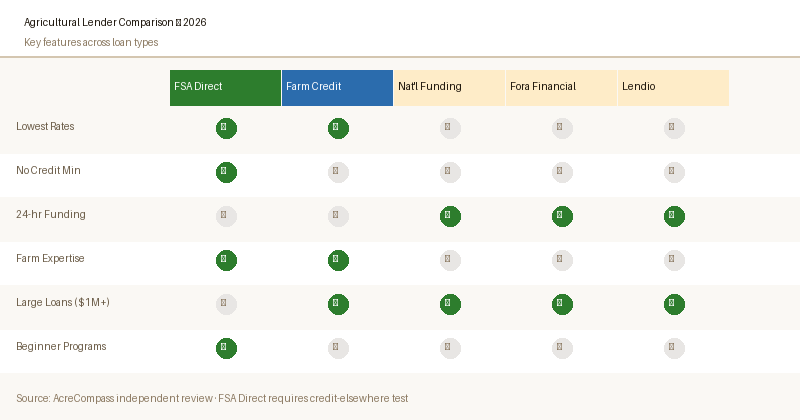
AcreCompass reviews agricultural lenders using a 100-point scoring rubric built specifically for farm and ranch lending.
Agricultural lending is a specialized field — the criteria that matter for a small business loan (speed, online process) are different from what matters for a 30-year farmland mortgage (rates, cooperative structure, agricultural expertise). We weight accordingly.
We built our methodology around the questions real farmers ask us most: What's the actual rate range? Will this lender work with my operation type? How painful is the application process?
What happens if I have a tough crop year? We weight our scores to reflect what matters most, based on ongoing reader feedback and our understanding of agricultural lending cycles.
Our scores reflect editorial judgment based on publicly available data, lender disclosures, user-submitted experiences, and our own mystery-shopping research. Lenders cannot pay for higher scores, favorable placement, or the removal of negative findings.
Scoring Criteria & Weights
Each lender is evaluated on a 100-point scale across five categories. The weights reflect what our readers consistently identify as most important in agricultural lending decisions.
| Category | Weight | What We Measure |
|---|---|---|
|
Rates & Fees
The biggest driver of total loan cost over a multi-year term.
|
30% | Starting rate range, typical APR for well-qualified borrowers, origination fees, prepayment penalties, annual line fees, and rate transparency — do they publish rates publicly or require application before disclosing terms? |
|
Loan Products & Flexibility
Whether the lender can meet a farm's full range of capital needs.
|
25% | Range of loan types (land, operating, equipment, construction), term options, minimum and maximum loan sizes, LTV policies, and programs for beginning farmers or underserved operations. |
|
Ease of Application
Time, paperwork, and friction from initial inquiry to approval.
|
20% | Online application availability, document requirements, typical decision timeline, prequalification options, and whether ag-specific financial formats (Schedule F, FSA records) are accepted natively. |
|
Customer Service & Ag Expertise
Whether the lender understands farming and treats borrowers well.
|
15% | Availability of dedicated agricultural loan officers, borrower testimonials and third-party reviews, BBB rating, hardship handling (drought, commodity price crashes), and whether local relationship banking is available. |
|
Transparency & Disclosure
Whether the lender is upfront about costs, terms, and eligibility.
|
10% | Public rate disclosure, clear eligibility criteria, fee disclosure before application, sample loan documents available, and responsiveness to information requests from our editorial team. |
Score Weight Distribution
How Star Ratings Are Assigned
Overall star ratings are derived from the 100-point score: 90–100 = 5 stars, 80–89 = 4.5 stars, 70–79 = 4 stars, 60–69 = 3.5 stars, below 60 = 3 stars or fewer.
We do not recommend lenders that score below 60 points — if a lender scores below our minimum threshold, they are not included in our recommendations but may be included in comparison tables for reference.
How We Collect Data
We use four primary methods to gather the information behind our lender scores:
- Public lender disclosures. Rate ranges, fee schedules, loan product pages, and application requirements published on lender websites. We screenshot and date-stamp all source materials to document what was publicly available at the time of our research.
- Direct lender outreach (mystery shopping). Our editorial team contacts lenders posing as prospective agricultural borrowers with plausible loan scenarios. We evaluate response time, quality of information provided, and whether loan officers demonstrate genuine agricultural expertise. We do this as mystery shoppers, not as media inquiries — because agricultural expertise in the loan officer conversation is a real quality that affects borrower outcomes.
- Reader experience surveys. We periodically survey AcreCompass readers who have completed a loan application or closed a loan with lenders we review. Their actual experiences — response time, documentation requests, whether rates matched what was advertised — inform our customer service scores.
- Third-party sources. Better Business Bureau ratings and complaint history, state agriculture department data, USDA FSA loan volume data, and HMDA agricultural loan data where applicable.
We do not use lender-provided marketing materials as a primary source for rate or fee claims.
If a lender's published website rate differs from what their sales team quotes during our mystery-shop calls, we flag the discrepancy and score transparency accordingly.
Our Review Process
Each lender review follows a standardized, six-step process before publication.
-
1Initial data collectionWe collect all public-facing rate, fee, and product information from the lender's website, document the access date, and note any information gaps where the lender requires application before disclosing terms.
-
2Mystery shop & outreachAn AcreCompass editor contacts the lender posing as a farmer with a plausible loan scenario. We evaluate response time, quality of information provided, and whether the loan officer asks the right agricultural questions and demonstrates familiarity with farm-specific documentation requirements.
-
3Score applicationWe apply our 100-point scoring rubric using the data collected. Each criterion is scored individually, then weighted and summed. Scores are documented in our internal scoring spreadsheet with source citations for each data point — so we can explain any score to a reader who asks.
-
4Editorial reviewA second AcreCompass editor reviews the score and draft review for factual accuracy and internal consistency. Disagreements on scores are resolved by discussion and documented in our internal records. The second reviewer must confirm all material claims before publication.
-
5Lender right of replyBefore publication, we send the lender a factual summary of our findings and invite them to correct any factual errors — not scores or editorial judgments. We allow 5 business days for response. We will correct genuine factual errors; we will not change editorial assessments, remove negative findings, or improve scores based on lender pressure or commercial considerations.
-
6Publication & ongoing monitoringThe review is published with a data-collection date displayed prominently. We set a calendar reminder for annual re-review and monitor for major lender changes — rate adjustments, product additions, regulatory actions, or credible user reports — that might warrant an earlier update.
Editorial Independence
Our most important commitment to readers is that our editorial scores and rankings are not for sale. Here is specifically what that means in practice:
- ✓ Lenders cannot pay to improve their score, star rating, or comparison ranking.
- ✓ Affiliate compensation does not affect which lenders we include or exclude from comparison pages.
- ✓ Default comparison sort order is by editorial score — not by affiliate payout (EPC).
- ✓ We include USDA FSA programs in all relevant comparisons even though we have no affiliate relationship with the government.
- ✓ Negative findings in our reviews are not removed as a condition of affiliate agreements.
- ✓ Our editorial team and commercial team operate independently. Editors are not compensated based on affiliate revenue from specific lenders.
A note on lender ordering on specific pages
We are transparent that on some pages — particularly "Best of" list pages — display order may reflect contextual factors beyond editorial score, such as affiliate relationship status, product availability in a reader's state, or minimum loan size relevance.
When this is the case, we say so on the page. The editorial scores themselves are never adjusted for commercial reasons.
Affiliate Relationships & Disclosure
Advertiser Disclosure
AcreCompass is reader-supported. Some lender links on our site are affiliate links — when you click through and complete a loan application or close a loan, we may receive a referral fee from the lender at no additional cost to you.
Not all lenders we review have affiliate arrangements with us. Our editorial scores, ratings, and recommendations are not influenced by whether an affiliate relationship exists.
On pages where affiliate links appear, we include an inline disclosure near the relevant links. See our full Advertiser Disclosure for a complete list of our current affiliate relationships.
Update Frequency
Lender rates, products, and policies change. Our update schedule:
- FSA rates: Updated within 2 business days of each USDA quarterly rate publication. USDA publishes FSA Direct and Guaranteed loan rates four times per year.
- Commercial lender rates: Audited monthly. If published rates on a lender's site have changed materially, we update our review and display the revision date.
- Full re-reviews: Each lender review undergoes a complete re-evaluation at least once per year, typically in Q1.
- Triggered updates: We update reviews immediately when we become aware of significant events — regulatory actions, material product changes, ownership changes, or credible user reports of discrepancies between our review and actual lender behavior.
Every page on AcreCompass displays a "Last updated" date so you can judge the freshness of the information yourself. We do not update this date cosmetically — it reflects when the underlying data was actually reviewed and confirmed.
Questions
We take accuracy seriously and welcome corrections. If you believe any information in our lender reviews is factually incorrect — including rates, fees, loan limits, or product availability — please contact our editorial team.
Editorial questions and corrections: editorial@acrecompass.com
If you are a lender or lender representative with a factual correction, please include documentation supporting the correction. We will review all factual correction requests within 5 business days and will update content and publish a correction note if warranted.
We will not engage with requests to improve scores or remove negative findings; we will promptly correct genuine factual errors.
Reader experiences are valuable
Have you recently closed an agricultural loan with a lender we review? Your real-world experience — good or bad — helps us improve our coverage.
If your experience differed significantly from what our review describes, we want to hear about it. Reader experience data is one of four sources we use to score lenders.