What Is a Farm Loan?
A farm loan is any type of credit specifically designed to finance agricultural operations — from buying land and purchasing equipment to covering day-to-day production costs like seed, fertilizer, and hired labor.
Farm loans differ from standard commercial loans in that they're sized around production cycles, seasonal cash flows, and the unique collateral value of farmland and equipment.
Agricultural lending in the United States is a
— USDA Agricultural Statistics$430billion market served by three main channels: the Farm Service Agency (FSA), a division of USDA that lends directly to farmers; the Farm Credit System, a network of federally chartered cooperatives; and commercial lenders ranging from community banks to online fintech companies.
Types of Farm Loans
Farm financing is not one-size-fits-all. The six primary loan types serve very different purposes, carry different rate structures, and come from different sources.
| Loan Type | Purpose | Max Amount | Typical Term | Who Offers It |
|---|---|---|---|---|
| FSA Operating (Direct) | Seeds, inputs, labor | $400K | 1–7 years | USDA FSA |
| FSA Ownership (Direct) | Buy or improve farmland | $600K | Up to 40 years | USDA FSA |
| Operating Line of Credit | Seasonal production costs | $500K+ | 12 months (renews) | Banks, Farm Credit, Online |
| Farm Mortgage | Land purchase or refinance | $2.24M+ | 15–30 years | Farm Credit, Banks, FSA Guaranteed |
| Equipment Loan | Tractors, combines, grain bins | $2M+ | 3–10 years | AgDirect, Farm Credit, Lenders |
| Emergency Loan | Disaster recovery | $500K | 1–40 years | USDA FSA (declared disaster areas) |
How We Picked the Best Farm Loans
Our editorial team evaluated eight lenders across five weighted criteria: interest rate and APR (30%), maximum loan amount and flexibility (20%), minimum eligibility requirements (20%), funding speed (15%), and customer support and borrower experience (15%).
We gave separate consideration to government programs — FSA loans — because their eligibility requirements and timelines differ fundamentally from commercial products.
We excluded lenders that could not verify current agricultural loan rates, charge prepayment penalties without disclosure, or had active regulatory actions.
All rates cited were verified as of May 2026 against lender disclosures and USDA published rate schedules.
Best Farm Loans: Our Rankings
1. Farm Credit Services — Best for Long-Term Land Loans
Farm Credit Services of America and its regional affiliates (AgriBank, CoBank, Farm Credit Mid-America) are member-owned cooperatives that return earnings to borrowers as patronage dividend (a rebate Farm Credit associations pay back to borrower-members from annual profits)s.
This cooperative structure means effective rates are often 0.25–0.75% lower than the stated rate after patronage refunds are factored in. For a 30-year land purchase, Farm Credit is typically the lowest-cost option available to well-qualified farmers. Starting rates as of May 2026 are approximately 5.85% on 30-year fixed notes.
2. National Funding — Fastest funding (1–3 business days)
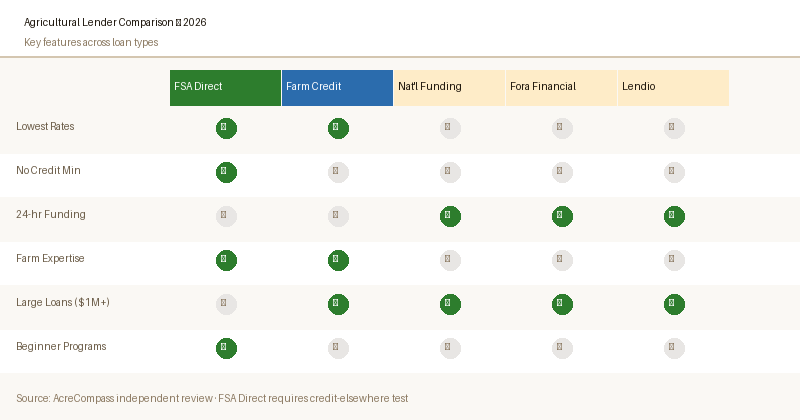
When you need operating capital within days — not weeks — National Funding is the most reliable option for farmers who don't qualify for or can't wait on FSA processing. Their agricultural lending division approves loans up to $500,000 based primarily on business revenue, with funding in as little as 24 hours.
The tradeoff is rate: National Funding's effective APR starts at approximately 7.00% and can run higher depending on credit profile. The speed premium is worth it for urgent planting season needs or bridge financing while waiting on an FSA decision.
3. FSA Direct Loans — Best Rate (4.75%)
The USDA Farm Service Agency's direct loan programs remain the most affordable agricultural financing in the United States for qualifying borrowers. The FSA Farm Ownership Direct loan rate stands at 4.75% as of May 2026 — the Operating loan rate is 5.25%.
The catch is time: FSA applications require a face-to-face appointment at your local service center, three years of financial records, and typically 30–60 days to close. Beginning farmers and farmers who cannot obtain credit elsewhere receive priority.
USDA FSA Direct Loans — No Affiliate Relationship
AcreCompass has no affiliate relationship with USDA. We include FSA programs because they offer the lowest rates available. Apply at fsa.usda.gov or visit your local FSA service center.
4. Lendio — Best Marketplace for Lower Credit Scores
Lendio is a lending marketplace that connects borrowers with 75+ lenders through a single application. For farmers with credit scores below 640 — common among beginning farmers and those who've faced crop losses — Lendio surfaces options that wouldn't be available through a single-lender application.
Lendio matches borrowers with SBA loans, equipment financing, and operating lines. Rates vary by matched lender; the Lendio process typically takes 2–7 days to fund.
5. Fora Financial — Best for Large Operating Loans
Fora Financial lends up to $1.4 million with minimal collateral requirements, making them the top choice for large grain operations or livestock farms with high working capital needs.
Their approval process emphasizes recent business revenue over tax returns, which helps farmers with complex ownership structures or recent expansion. Rates start at approximately 7.00% and are priced on individual risk factors.
6. AgDirect / Farm Credit Equipment — Best for Equipment
AgDirect, operated through Farm Credit Services of America, specializes in agricultural equipment financing with rates starting around 5.90%. Their point-of-sale lending through equipment dealers makes the financing process seamless for major purchases.
Terms extend to 10 years for qualifying equipment. Southern AgCredit also offers competitive equipment and land loan rates in the southeastern United States.
Full Comparison Table
| Lender | Best For | Rate Range | Max Loan | Term | Score | Apply |
|---|---|---|---|---|---|---|
| Farm Credit | Land loans | 5.85%+ | $2M+ | 30 yr | ★ 4.8 | Apply → |
| National Funding | Fast operating | 7.00–24% | $500K | 2–5 yr | ★ 4.6 | Apply → |
| FSA Direct | Lowest rate | 4.75–5.25% | $600K | Up to 40 yr | ★ 5.0 | Visit FSA → |
| Lendio | Bad credit | Varies | $5M | Varies | ★ 4.4 | Apply → |
| Fora Financial | Large loans | 7.00–35% | $1.4M | 4–15 mo | ★ 4.5 | Apply → |
| AgDirect | Equipment | 5.90%+ | $2M+ | Up to 10 yr | ★ 4.7 | Apply → |
Affiliate disclosure: AcreCompass may earn a commission if you apply through commercial lender links on this page. This does not affect our ratings. FSA links are not affiliate links.
Compare Farm Loan Rates From Multiple Lenders
Use Lendio's marketplace to see rates from 75+ lenders with a single application. No hard credit pull to see initial offers.
FSA vs. Commercial: How to Choose
The decision between FSA and commercial lending comes down to three factors: time, eligibility, and rate sensitivity.
FSA loans take 30–60 days and require a face-to-face appointment with your county service center. Commercial loans can fund in days but cost 2–5 percentage points more annually.
Use FSA if: you have time to wait, you've been declined by a commercial lender, or you're a beginning farmer eligible for priority treatment.
Use a commercial lender if: you need capital in the next 2 weeks, your operation doesn't qualify for FSA eligibility, or the paperwork burden of FSA applications outweighs the rate savings on a small loan amount.
Frequently Asked Questions
What credit score do I need for a farm loan?
What's the difference between FSA and Farm Credit?
Can I get a farm loan with no down payment?
How long does farm loan approval take?
What is the FSA interest rate in 2026?
Can I use a farm loan to buy any type of farmland?
Sources
- USDA Farm Service Agency — Farm Loan Programs, rates as of May 2026
- Farm Credit Administration — 2025 Annual Report on the Farm Credit System
- USDA National Agricultural Statistics Service — 2025 Agricultural Finance Databook
- Federal Reserve Bank of Kansas City — Agricultural Finance Databook, Q1 2026