Pros
- FSA emergency loan rate for real estate losses (3.75%) is the lowest of any disaster recovery financing
- Up to
$500Kavailable for qualifying disaster-affected operations - Covers both physical losses (buildings, fences, equipment) and production losses (crops, livestock)
- LFP and LIP provide direct payments with no repayment required
- Can be combined with crop insurance payouts and FEMA assistance
Cons
- Requires a presidential or Secretarial disaster declaration in your county
- Must demonstrate at least 30% production loss to qualify
- 8-month application deadline — miss it and you lose access
- Processing still takes weeks through FSA even in emergencies
- Non-real estate emergency rate (8.00%) is higher than standard FSA operating
Who This Is For
Farmers in USDA-declared disaster areas who have suffered crop failures, livestock losses, or property damage from drought, flood, tornado, wildfire, or other qualifying disasters. Apply within 8 months of the declaration.
Who Should Look Elsewhere
Operations outside a declared disaster area cannot access FSA emergency loans. If your losses are covered by crop insurance, file that claim first — it processes faster and does not require repayment.
FSA Emergency Loans: How They Work
Watch this USDA explainer video:
The USDA Farm Service Agency's Emergency Loan program (often called "EM Loans") provides operating and real estate loans to farmers who have suffered losses from natural disasters. Unlike standard FSA loans, emergency loans require that your county be designated as a disaster area.
Eligibility Requirements
To qualify for an FSA Emergency Loan, you must meet all of the following criteria:
- Your farm is located in a county designated as a disaster area by presidential declaration or a USDA Secretarial designation
- You suffered a substantial loss in production — generally defined as a loss of 30% or more of any crop, or damage to real estate or chattel property
- You have a history of agricultural experience in the type of operation for which you are requesting the loan
- You are unable to obtain adequate commercial credit at reasonable rates
- You were actively farming at the time of the disaster
Loan Limits and Rates
FSA Emergency Loan parameters as of May 2026:
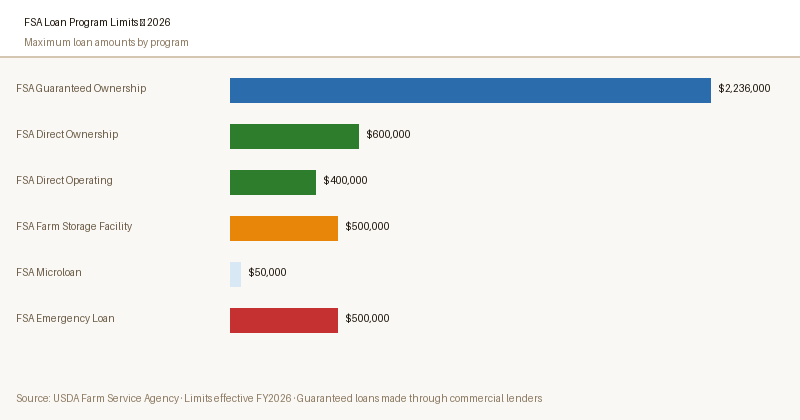
- Maximum loan amount:
$500,000 - Interest rate (non-real estate): 8.00% — for seed, livestock, equipment, and operating expenses
- Interest rate (real estate): 3.75% — for land and permanent improvements damaged in the disaster
- Term: Up to
7 yearsfor non-real estate; up to 40 years for real estate - Application deadline: Generally 8 months after the date of the county's disaster designation
How to Find Out If Your County Is Declared
USDA maintains a searchable disaster designation database at fsa.usda.gov. Designations come in two forms:
- Presidential Major Disaster Declaration — Issued by the White House for large-scale disasters; counties can be designated as "primary" or "contiguous" counties. Farmers in contiguous counties are also eligible for FSA EM loans.
- USDA Secretarial Designation — Issued by the Secretary of Agriculture for agricultural disasters that don't rise to the level of a presidential declaration. Drought, freeze, excessive moisture, and commodity losses most commonly trigger secretarial designations.
You can also call your local FSA county service center directly — they track designations as they are issued and will tell you immediately whether your county qualifies. Keep your county FSA service center's number saved: it's the first call you should make after any significant weather event or crop loss.
USDA FSA Emergency Loans — No Affiliate Relationship
Apply for FSA Emergency Loans at fsa.usda.gov or contact your county FSA service center. AcreCompass has no affiliate relationship with USDA. Emergency loan funds are limited and processed in order received.
USDA Disaster Programs (Beyond EM Loans)
FSA administers several disaster assistance programs in addition to Emergency Loans. Understanding which programs apply to your situation can maximize your recovery options:
| Program | Covers | Trigger | Type | Apply |
|---|---|---|---|---|
| FSA Emergency Loan (EM) | Crops, livestock, equipment, real estate | Disaster declaration + 30% loss | Loan (repay) | FSA.usda.gov → |
| Livestock Forage Disaster (LFP) | Grazing losses from drought or fire | Drought intensity + secretarial | Payment (no repay) | FSA.usda.gov → |
| Livestock Indemnity (LIP) | Livestock deaths from natural disaster | Disaster declaration | Payment (no repay) | FSA.usda.gov → |
| Noninsured Crop Disaster (NAP) | Uninsured crops below 50% yield | Natural disaster, no crop insurance | Payment (no repay) | FSA.usda.gov → |
| National Funding | Operating capital, replanting, bridge | None required | Loan (repay) | Apply → |
FSA programs: no affiliate relationship with USDA. National Funding: affiliate link — we may earn a commission.
Commercial Emergency Options
When your county is not in a declared disaster area, or when you need capital faster than FSA can process your application, commercial lenders provide the only available emergency financing.
National Funding — 24-Hour Bridge Financing
National Funding's operating loan product — approved in 24 hours, funded in 1–3 business days — is the fastest bridge capital available for farmers in non-declared areas or those waiting on FSA decisions. Loan amounts up to $500,000. The rate is higher than FSA (7.00%+), but when the alternative is losing a crop because you can't afford replanting inputs, the rate premium may be the right tradeoff. Many farmers use National Funding as a bridge, then pay off the loan once FSA or crop insurance proceeds arrive.
Fora Financial
For larger emergency capital needs — replacing flood-damaged equipment, rebuilding grain storage, or restoring irrigation systems — Fora Financial lends up to
— Farm Credit Administration$1.4 million with decisions in 24–72 hours. Their underwriting emphasizes recent business revenue, which works in favor of farms that suffered a current-year loss but have a strong prior history. Rates are higher than AgDirect or Farm Credit but competitive for emergency financing without collateral.
Working with Crop Insurance First
Crop insurance is your primary financial protection layer — FSA emergency loans are the backup. The sequence matters:
- File a notice of loss with your crop insurance agent immediately — most policies require notice within 72 hours of discovering damage
- Document losses thoroughly before any cleanup or replanting — photos, yield records, written descriptions
- Do not destroy or plow under damaged crops without notifying your insurance agent first — this can void your claim
- Request an adjuster visit and cooperate fully with the loss adjustment process
- Once the insurance claim process is underway, contact your FSA service center if losses exceed what crop insurance will cover
Many FSA emergency loan applications reference crop insurance indemnity payments as part of the financial plan for repayment. Lenders also expect that you'll use crop insurance proceeds first — demonstrating that you exhausted available resources before seeking a loan strengthens your FSA application.
Application Checklist for FSA Emergency Loans
Documents to Prepare for Your FSA Emergency Loan Application
- Proof of disaster designation for your county (date and designation type)
3 yearsof farm tax returns (Schedule F) or business returns- Current farm balance sheet (assets and liabilities as of application date)
- Documentation of losses: photos, yield records, insurance adjuster reports
- Crop insurance policy number and status of any pending claim
- A written statement describing the nature and extent of your losses
- Production records for the crops or livestock affected (5-year average yields if available)
- Estimates or invoices for proposed uses of loan funds (replanting, repairs, replacements)
- Evidence of inability to obtain commercial credit (written lender declination if available)
- FSA Loan Application
Form 2001(available at your service center)
Need Recovery Capital While Waiting for a Declaration?
National Funding provides bridge financing in 24 hours — no disaster declaration required. Use it to replant, replace lost inventory, or cover operating gaps while FSA processes your application.
Frequently Asked Questions
Does my county need to be in a disaster declaration to get an FSA emergency loan?
How much crop loss is required to qualify for an FSA emergency loan?
What is the deadline to apply for an FSA emergency loan?
Can I get an emergency farm loan for drought losses?
What happens if I can't repay an FSA emergency loan?
Is there an emergency farm loan for floods specifically?
Sources
- USDA Farm Service Agency — Emergency Loan Program, rates verified May 2026
- USDA Farm Service Agency — Disaster Designation Handbook, 2025
- USDA Risk Management Agency — Crop Insurance Summary of Business, 2025
- USDA Economic Research Service — Natural Disaster Costs in U.S. Agriculture, 2024