Farm Loan Payment Calculator
Enter your loan details to estimate your monthly payment and total cost. Rates updated May 2026.
Loan Details
Rate Comparison
Amortization Schedule
First 12 months shown| Month | Payment | Principal | Interest | Balance |
|---|
How to Use This Calculator
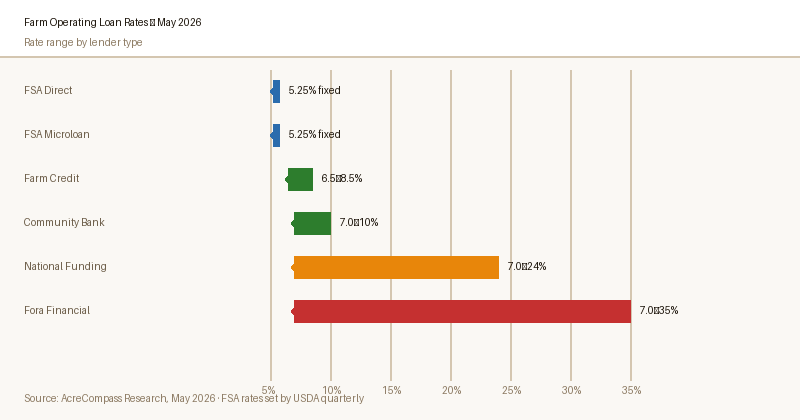
Enter your loan amount, the annual interest rate quoted by your lender, and the loan term in years. The calculator instantly outputs your estimated monthly payment, the total interest you'll pay over the life of the loan, and an amortization schedule showing how each payment splits between principal and interest reduction.
If you're comparing multiple lenders, run the calculation at each lender's quoted rate to see the real dollar cost difference over the full term. A 1% rate difference on a
— USDA Agricultural Finance Data, 2026$500,000loan over20 yearstranslates to roughly $60,000 in additional interest.
The "Loan Type" dropdown updates the benchmark note below the inputs with current rate context for that loan category — useful for understanding how your quoted rate compares to government and commercial options.
Results calculate automatically as you type or adjust the slider. Use the amortization table to see exactly how much of each payment goes to reducing principal versus paying interest — in the early years of a long-term loan, most of each payment is interest.
Not sure about your rate?
FSA Direct farm ownership loans are currently 5.50%. Farm Credit institutions typically start at 5.85–6.5%. Use the lender comparison page to get real quotes.
Understanding Your Results
The Monthly Payment shown is the fixed amount required each month to fully repay your loan by the end of the term — this is the standard amortizing payment calculation used by all banks and the USDA.
The Total Interest Paid figure shows the true cost of borrowing: all monthly payments added up, minus the original principal. For long-term land loans this number is often larger than the original loan amount — this is normal and not an error.
The Effective Annual Cost % expresses total interest as a percentage of your original principal, which helps you compare loans with different terms on an apples-to-apples basis. A 7% rate over 30 years has a much higher effective cost than 7% over 5 years.
The Rate Comparison chart anchors your rate against the current FSA Direct floor (5.50%) and the approximate commercial ceiling (24%), so you can see where you fall in the market at a glance.
Fixed vs. variable rates
This calculator assumes a fixed rate. Variable-rate loans (common with Farm Credit operating lines) will have actual payments that change as rates move. Use the current rate for an approximate estimate.
Compare Current Farm Loan Rates
Use your calculated payment as a baseline, then check real quotes from verified agricultural lenders — no hard credit pull to see initial rates.