In fiscal year 2024, the USDA Farm Service Agency made approximately
— USDA Farm Service Agency, FY2024 Annual Report$5.8 billion in farm loans to more than 115,000 farmers and ranchers — making it one of the largest agricultural lenders in the United States.
A
- AgDirect
- A specialized agricultural equipment financing program offered through Farm Credit Services of America and Frontier Farm Credit. AgDirect provides competitive fixed-rate equipment loans for tractors, combines, grain bins, and other farm machinery with terms up to 84 months. See also: AgDirect Review
- APH — Actual Production History
- A farmer's documented per-acre yield record maintained over time by their crop insurance agent. APH data typically spans
4–10 years; yields are averaged to establish the APH yield, which serves as the baseline for calculating how much coverage a crop insurance policy provides. A higher APH yield means higher dollar coverage per acre. Transitional yields (T-yields) are used to fill gaps in a farmer's production history. See also: APH Guide - ARC — Agriculture Risk Coverage
- A USDA commodity support program that makes payments when county or individual revenue falls below a benchmark level. ARC is elected on a farm-by-farm basis through the Farm Service Agency and is an alternative to the Price Loss Coverage (PLC) program. ARC payments are triggered by actual declines in crop revenue, not just price declines.
B
- Balloon Payment
- A large, lump-sum payment due at the end of a loan term after a series of smaller regular payments. Some commercial farm loans use balloon structures — for example, a 5-year term with monthly interest-only payments and the full principal due at maturity. FSA direct loans do not typically use balloon structures.
- Beginning Farmer
- A USDA-defined category for farmers and ranchers who have operated a farm or ranch for 10 years or fewer. Beginning farmers receive priority processing for FSA direct loans, dedicated funding set-asides, and access to special loan programs including the Beginning Farmer Down Payment Loan. See also: Beginning Farmer Loans Guide
- Benchmark Yield
- In crop insurance, the yield level against which actual yields are compared to determine whether a loss payment is triggered. For APH-based policies, the benchmark is typically 65–85% of the APH yield, depending on the coverage level chosen.
C
- Cash Flow Projection
- A financial document showing expected income and expenses month-by-month over one or more production years. FSA requires a cash flow projection as part of all direct loan applications. Lenders use cash flow projections to assess whether a farm operation can service proposed debt. A strong cash flow projection is the single most important document in a farm loan application.
- Collateral
- Assets pledged to secure a loan — if the borrower defaults, the lender may claim the collateral to recover losses. Common farm loan collateral includes: growing crops, harvested grain inventory, farm machinery and equipment, farm real estate (land and buildings), and livestock. FSA direct loans require all available collateral to be pledged.
- Coverage Level
- In federal crop insurance, the percentage of the APH yield or revenue benchmark that the policy guarantees. Common coverage levels range from 50% to 85%, in 5% increments. A higher coverage level means more protection but higher premiums. At 85% coverage, the policy triggers if the farmer's actual yield falls below 85% of their APH yield.
- Credit-Elsewhere Test
- The FSA requirement that applicants for Direct loans must demonstrate they cannot obtain credit from commercial sources at reasonable rates and terms. FSA is a lender of opportunity — not a lender of last resort. Applicants who have been declined by a commercial lender typically satisfy this requirement by providing a written declination letter from the lender. See also: FSA Loans Guide
- Crop Year
- The production cycle for a given crop, typically defined as the period from planting to the final sale of harvested grain. For winter wheat, the crop year runs from fall planting through summer harvest. For corn and soybeans, the crop year runs spring to fall. Loan terms, insurance policies, and FSA program elections are often tied to the crop year.
- CRP — Conservation Reserve Program
- A USDA voluntary program that pays farmers annual rental payments to remove environmentally sensitive land from agricultural production and plant species that improve environmental quality. CRP contracts typically run
10–15 years. CRP payments can serve as stable income for loan repayment purposes.
D
- Direct Loan (FSA)
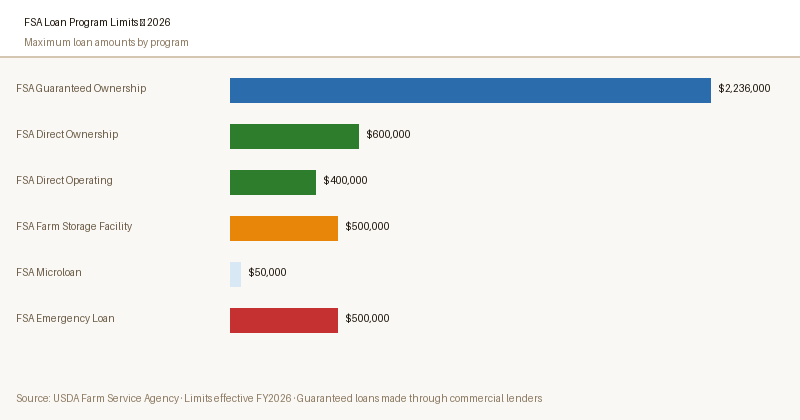
- A loan made directly from USDA to the borrower, funded by the federal government. Unlike a guaranteed loan, there is no commercial bank involved — the FSA service center is the lender. Direct loans have lower interest rates than guaranteed loans because they are funded by the Treasury. Maximum:
$600,000for ownership, $400,000 for operating, $50,000 for microloans. See also: Direct vs. Guaranteed Loans - Draw (Draw Request)
- A request to advance funds from an approved line of credit. Unlike a term loan (where the full amount is disbursed at once), a line of credit allows the borrower to draw funds as needed, up to the approved limit. Interest accrues only on outstanding balances between draw and repayment.
E
- Emergency Loan (FSA)
- An FSA loan available to farmers in counties that have received a presidential disaster declaration or a USDA secretarial disaster designation. Emergency loans cover actual losses caused by the disaster and can be used to restore or replace essential property, pay all or part of production costs associated with the disaster year, or pay essential family living expenses. See also: Emergency Farm Loans Guide
- Equipment Loan
- A term loan secured by farm machinery, equipment, or other titled assets. Equipment loans typically have terms of 5–10 years, matching the useful life of the collateral. The equipment purchased serves as primary collateral. AgDirect and Farm Credit are common equipment lenders; FSA also makes equipment loans through its operating loan program. See also: Equipment Financing Guide
- EQIP — Environmental Quality Incentives Program
- A USDA Natural Resources Conservation Service (NRCS) cost-share program providing financial and technical assistance to implement conservation practices. EQIP payments are not loans — they are grants for practices like cover cropping, irrigation efficiency, and nutrient management. EQIP is often used in conjunction with farm loans to reduce the net cost of capital improvements.
F
- Farm Credit System
- A network of government-sponsored cooperative lending institutions serving agriculture across the United States. The Farm Credit System includes Farm Credit associations (local lending), Farm Credit banks (funding), and specialized institutions including CoBank and AgriBank. Farm Credit is borrower-owned — when you borrow, you may receive patronage dividends based on system earnings. See also: Farm Credit Services Review
- Farm Credit Services of America (FCSA)
- One of the largest Farm Credit associations, serving farmers in Iowa, Nebraska, South Dakota, and Wyoming. FCSA provides real estate loans, operating lines, equipment financing, and crop insurance. It is a cooperative owned by its borrowers and is among the largest private agricultural lenders in the United States.
- FSA — Farm Service Agency
- A branch of the U.S. Department of Agriculture (USDA) that administers farm loan programs, disaster assistance, conservation programs, and commodity support. FSA operates through a network of more than 2,100 county service centers. FSA loan programs include Direct Loans, Guaranteed Loans, Microloans, Farm Storage Facility Loans, and Emergency Loans. See also: Complete FSA Loan Guide
- Farm Storage Facility Loan (FSFL)
- An FSA loan program for constructing or upgrading on-farm storage for grain, hay, cold storage, or other commodities. FSFLs offer below-market fixed interest rates and terms up to 12 years. Borrowers can construct grain bins, silos, hay barns, or refrigerated facilities for specialty crops. No down payment is required for loans under
$50,000. See also: Farm Storage Facility Loans Guide - Fora Financial
- A commercial lender that provides business term loans and revenue-based financing to agricultural operations. Fora Financial evaluates recent business performance rather than traditional collateral, making it suitable for operations that have grown rapidly or recently restructured. Loan amounts up to
$1.4 million; rates vary by risk profile. See also: Fora Financial Review
G
- Guaranteed Loan (FSA)
- A commercial loan where USDA guarantees up to 95% of the principal against loss. The commercial lender (a bank or Farm Credit association) makes and services the loan using its own funds; USDA's guarantee reduces the lender's risk, allowing approval of loans that might otherwise not qualify. Maximum:
$2,236,000. Rates are negotiated with the commercial lender and are typically lower than unguaranteed commercial rates. See also: Direct vs. Guaranteed Comparison - Grain Bin Loan
- A loan for constructing or purchasing on-farm grain storage bins. Grain bin loans are available through FSA (as Farm Storage Facility Loans), Farm Credit, and commercial lenders. On-farm storage increases a farmer's marketing flexibility by allowing grain to be sold when prices are favorable rather than immediately at harvest.
I
- Indemnity
- In crop insurance, an indemnity is a payment made by the insurer when the farmer's actual yield or revenue falls below the guaranteed level. The indemnity amount equals the shortfall multiplied by the price election. Indemnities are paid after harvest when actual production is known and loss is documented.
L
- Lendio
- A loan marketplace that connects agricultural borrowers with over 75 lenders through a single application. Rather than a direct lender, Lendio is an aggregator — it matches your application to lenders whose criteria you meet, giving you multiple offers to compare. This is useful for farmers who don't know which commercial lender is right for their situation. See also: Lendio Review
- Line of Credit (Agricultural)
- A revolving credit facility that allows a borrower to draw funds as needed, repay, and draw again up to an approved limit. Interest accrues only on outstanding balances. Agricultural lines of credit are typically renewed annually. Community banks and Farm Credit associations commonly offer revolving agricultural lines. FSA typically structures direct operating loans as term loans rather than revolving lines.
- Loss Ratio (Crop Insurance)
- The ratio of indemnity payments to premiums collected for a given crop, region, or policy type. A loss ratio above 1.0 means the insurer paid out more than it collected. Loss ratios are used by the USDA Risk Management Agency to assess the financial performance of the federal crop insurance program by crop and county.
M
- Microloan (FSA)
- A simplified FSA direct loan of up to
$50,000with reduced documentation requirements. Microloans do not require the farmer to demonstrate they were turned down by a commercial lender. They are designed for small, beginning, niche, and specialty crop farmers. The interest rate is the same as the standard FSA direct operating loan rate. See also: FSA Loans Guide - MPCI — Multi-Peril Crop Insurance
- The standard category of federally subsidized crop insurance covering yield losses from multiple covered causes, including drought, excessive moisture, hail, wind, frost, insects, and plant disease. MPCI is the umbrella term for policies including Yield Protection (YP), Revenue Protection (RP), and Revenue Protection with Harvest Price Exclusion (RP-HPE). See also: How Crop Insurance Works
O
- Operating Loan
- A short-term loan covering the day-to-day costs of running an agricultural operation for one production season. Eligible uses include seed, fertilizer, pesticides, fuel, crop insurance premiums, hired labor, livestock feed, and cash rent. Operating loans are repaid after harvest. FSA offers direct operating loans at 5.25% (May 2026); commercial operating lines start at 6.5–7.0%. See also: Farm Operating Loans Guide
- Ownership Loan (Farm Ownership Loan)
- A long-term loan for purchasing, enlarging, or improving a farm or ranch, including the construction of buildings. FSA direct farm ownership loans have a maximum of
$600,000and a fixed rate of 5.50% (May 2026), with terms up to 40 years. Commercial real estate lenders and Farm Credit offer comparable products at negotiated rates. See also: Farm Ownership Loans Guide
P
- Patronage Dividend
- A return of earnings to borrower-members of Farm Credit cooperatives, paid in proportion to the amount of business they did with the institution. Patronage dividends effectively reduce the net interest rate on Farm Credit loans. Patronage is not guaranteed and varies year to year based on the association's financial performance.
- PLC — Price Loss Coverage
- A USDA commodity support program that makes payments when the market year average price for a covered commodity falls below the effective reference price. PLC is elected on a farm-by-farm basis through FSA and is an alternative to the Agriculture Risk Coverage (ARC) program. PLC is generally more valuable when commodity prices are expected to be low.
- Price Election
- In crop insurance, the projected price set by USDA's Risk Management Agency before planting, used to calculate the revenue guarantee for Revenue Protection policies. The price election for corn and soybeans is established in February for the coming crop year. Farmers choose to insure between 55% and 100% of the price election.
R
- RMA — Risk Management Agency
- The USDA agency that administers the federal crop insurance program. RMA oversees approved insurance providers (AIPs), sets policy terms and premium rates, and manages the Standard Reinsurance Agreement with private insurers. All federally subsidized crop insurance is sold and serviced by private agents but backed and regulated by RMA. See also: How Crop Insurance Works
- Revenue Protection (RP)
- The most common type of federal crop insurance, covering revenue losses from yield shortfalls, price declines, or both. RP guarantees a minimum revenue per acre calculated as: APH yield × price election × coverage level. If the farmer's actual revenue (actual yield × higher of spring or harvest price) falls below this guarantee, the policy pays the difference. See also: Revenue Protection Guide
- Revolving Line of Credit
- A credit facility that allows funds to be drawn, repaid, and drawn again repeatedly up to an approved limit, within the term of the agreement. Interest is charged only on the outstanding balance. Revolving lines are common for multi-crop operations where expenses occur on different schedules throughout the year. See: Line of Credit.
S
- Schedule F
- IRS
Form 1040, Schedule F — the tax form used by sole proprietor farmers to report farm income and deductible expenses. Schedule F data (typically 3 years) is required for FSA loan applications and most commercial agricultural loan underwriting. Farm corporations and partnerships use business tax returns instead of Schedule F. - SCI — Supplemental Coverage Index
- An area-based crop insurance endorsement that covers the deductible of an underlying MPCI policy using county-level loss triggers. SCI is designed to complement RP or YP policies by providing additional coverage when widespread county-level losses occur. Premiums are subsidized and typically lower than equivalent individual-coverage upgrades.
- Seasonal Note
- A single-advance operating loan structured to be repaid in full at the end of the production season — typically after crop sale. FSA direct operating loans are usually structured as seasonal notes. Contrast with a revolving line of credit, where funds can be drawn and repaid multiple times within the year.
- FSA Service Center
- A local USDA Farm Service Agency office, typically organized by county. All FSA direct loan applications must be submitted in person at the applicant's local service center. There are more than 2,100 county service centers across the United States. Find your local office at fsa.usda.gov.
U
- Underserved Farmer
- A USDA-defined category including socially disadvantaged farmers (those who belong to groups that have been subject to racial or ethnic prejudice) and beginning farmers. Underserved farmers receive priority consideration for FSA direct loans and may access special programs including the Minority and Women Farmers and Ranchers loans.
- USDA — U.S. Department of Agriculture
- The U.S. federal cabinet agency responsible for policies and programs related to farming, food, natural resources, rural development, and nutrition. Within USDA, the agencies most relevant to farm finance are: the Farm Service Agency (FSA), the Risk Management Agency (RMA), the Natural Resources Conservation Service (NRCS), and the Rural Development mission area.
W
- WFRP — Whole-Farm Revenue Protection
- A federal crop insurance policy that insures the total revenue of an entire farm operation — all commodities, all fields — rather than individual crops. WFRP is especially valuable for diversified operations growing three or more commodities, or for farms with a significant specialty crop, livestock, or organic component. The revenue guarantee is based on the farm's historical revenue from Schedule F. See also: WFRP Complete Guide
- Working Capital
- The difference between a farm's current assets (cash, grain inventory, growing crops, short-term receivables) and current liabilities (operating loan balances, accounts payable, current portion of long-term debt). Working capital is a key metric for agricultural lenders — positive and growing working capital indicates a financially healthy operation. A working capital ratio below 1.0 is considered a warning sign.
- Yield Protection (YP)
- A federal crop insurance policy that protects against yield losses only — not price declines. YP guarantees a minimum yield per acre based on the farmer's APH yield and chosen coverage level. YP is simpler and usually cheaper than Revenue Protection, but provides no protection if yields are normal and prices fall sharply. Most row crop farmers prefer RP over YP for this reason. See also: Revenue Protection vs. Yield Protection
Sources
- USDA Farm Service Agency — Loan Program Descriptions
- USDA Risk Management Agency — Crop Insurance Topics
- Farm Credit Administration — FCA.gov
- IRS Publication 225 — Farmer's Tax Guide (2026 edition)
- Federal Reserve Bank of Kansas City — Agricultural Finance Databook, Q1 2026